Podcast Bumper Music
This is a blog to support a podcast of Bumper Music. You know, the kind of music that radio stations use to end a piece on a really deep topic, they play some deep music. I hope to have this music show up on iPods everywhere, in between the talk shows and ravings of the Podcasting lunatics. Subscribe and you will hear. If you are a musician intrigued by the idea of creating a short (30-60) second piece that will show up at random places in iPods everywhere, send me a link and I'll include them.
Sunday, March 28, 2010
Now Thank We All Our God - find those commas!
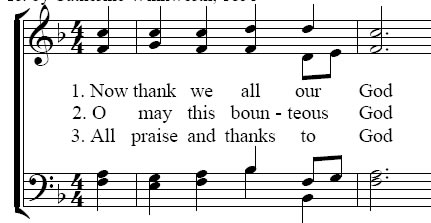
I'm still working my way through this one. I've found a few errors in my note choices today. At one point the score calls for a D and a G, and I used the D at ratio of 10/9 instead of the 9/8 to go with the G at 3/2. Not so nice.
At one point in chords 35 - 39 I need a G to go with the D at 10/9 and the Bb at 16/9, and with a C 1/1 E 5/4. So I chose a G 40/27 that drifts up by a step in 72 EDO to a G at 3/2 when it needs to match the C1/1. See the chart for the details. This section is heard at the end of today's excerpt. Find those commas to solve the wolf problems.
Play it:
Subscribe here:

Tuesday, March 16, 2010
Now Thank We All Our God - quite the crowd
This is a work in progress. Tonight, as I was enjoying my evening alone in the Salt Lake City Hilton near the airport, Omar showed up with his spinet, a blind guy who played the vibes, and a one armed marimba player. Next thing you know, the guy in the room down the hall knocked on the door. He said he could play four clarinets at once. In 72 EDO! I have never seen that before. So I had to record one more take of the first seven chords of Now Thank We All Our God. Heavenly. Fake but accurate...
Play it:
Monday, March 15, 2010
Friday, March 12, 2010
A Mighty Fortress Is Our God - Transformed take 9
I retuned the instrument samples using a much more accurate tool (my ears). The high flute samples were out of tune before. Now they sound much better. I also fixed a bug in the hold values for the flute part in the last section, so that they don't get chopped off early. This version should be the last one posted.
Play it:
Subscribe here:

Wednesday, March 10, 2010
A Mighty Fortress Is Our God - Transformed take 5
This version is much tighter now, and I think it's finished. The hymn tune was written by Martin Luther in 1529, and harmonized by Bach in 1740 or so. This version stretches each chord in a variety of ways. Each chord can be 2, 3, 4, or 5 times longer than normal, and is repeated 1, 2, or 3 times before moving on to the next chord. There is a variable repetition scheme that includes stepping through the choices of arpeggios in sequence, forward and backward, and staying put for a while. The tempo shifts constantly, as does the volume.
The intonation system is chosen from the 72 EDO scale. The notes include the following:
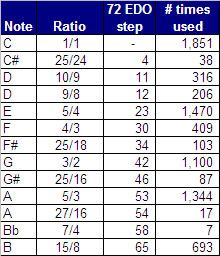
Notice how many more times C, E, G, and A are played. The two D's are less than half as common, and that lonely 7/4 is only played 7 times. See if you can hear it, towards the end.
This version is scored for vibraphone, marimba, finger piano, tuba, trombone, French horn, and flutes.
Here is a link to a nice PDF of the file on the Center for Church Music site. It's not the one I used, but it's close.
Play it:
Subscribe here:

Saturday, March 06, 2010
A Mighty Fortress Is Our God
This is a work in progress.
Play it:
Subscribe here:

Martin Luther is credited with this hymn in 1529. Today i present a simple statement of the opening few notes. Familiar? I can't decide if the penultimate chord, on the word "Our" should be
D 10/9 - F# 25/18 - A 5/3 or
D 9/8 - F# 45/32 - A 27/16. Decisions, decisions. Here it is as the latter.
Play it:
Thursday, March 04, 2010
I just noticed this video of a 60x60 concert in NYC with my short piece for
bassoon, bent wire spring, and percussion board.
60x60 Dance (2008 International Mix) performed at the World Financial Center Winter Garden in New York City on Friday, November 14, 2008. Music: Prent Rodgers Dance: Elana B Cohen
The rules stipulate that all compositions be no more than 60 seconds in length, which are assembled into concerts of 60 at a time. The whole operation is run by Robert Voisey. More information here: http://www.VoxNovus.com
For this 2008 performance, Robert enlisted a group of very talented dancers. More here.
He has also worked with Aaron Krister Johnson on a microtonal 60x60, which I think has been assembled for a concert in Chicago that Aaron is organizing for April 27th MCA Chicago 60x60/UnTwelve mix.
Prent Rodgers
Update: Here is a picture of the "Bent Wire Spring", an instrument I built back in the 70's. It is a block of birch, about 3/4" by 4" by 10", with a groove cut out for an angle iron fabrication with mid-gauge piano wires coming out. In the middle of the angle iron is a hand wound magnetic pickup that goes to an amplifier. The piano wires are bent into random shapes. You pluck the wires and each makes its own enharmonic spectrum with deep bass tones and an assortment of harmonics. Click the photo to enlarge.
Tuesday, March 02, 2010
The Music of the Hoh River Valley CD now up on iTunes
I worked with CDBaby (and paid them $45) to put my last CD up on iTunes. It took a few weeks, but you can find it now on iTunes. It's an experiment.