This is a work in progress...
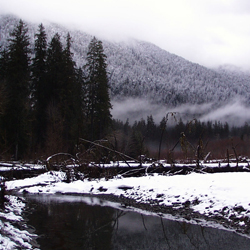
I was able to convince the gang to stick around for a few more takes of the piece. Thanks to Omar the tuba player for helping me revoice the winds to lower octaves. We spent all day Sunday running new takes, but something seemed to get in the way with each one. Finally we were able to get a good run through on the 17th try Monday morning. This one includes clarinet, oboe, tuba, marimba, vibes, finger piano, harp, and cello, plus the opening notch filtered wind tunnel sound recorded at the NASA Ames Research Center. As always, fake but accurate is my motto. Blue Glacier starts near the top of Mount Olympus, and terminates into Glacier Creek, which eventually flows into the Hoh River.Microtonal Music is music using more than 12 tones per octave. I compose music using Csound and a preprocessor I wrote in Turbo Pascal. I post small updates as the compositions are being created, and a few final versions once I'm done. I strive towards music that could be played if we had the instruments capable of playing the notes. Think of it as "fake but accurate".
Monday, February 09, 2009
Sunday, February 08, 2009
Walking Down the Hoh Glacier

Listen here:
This is a work in progress...
This is the second piece in the RPM Challenge. 10 songs or 35 minutes of recordings in the month of February. Onward down the valley.
Saturday, February 07, 2009
Stumbling over some rocks on the way down
Friday, February 06, 2009
Wednesday, February 04, 2009
Approaching the Bergschrund at Night
Dick Hogle's Liquid Light Show
Tuesday, February 03, 2009
Near the peak of Mt. Olympus
This is a work in progress...
The winds tend to howl at this elevation, especially when the storms blow in from the Pacific. Warm wet clouds this evening had a eerie sound as they blew up the glacier from the west. In this case, a descending utonality from 3:2 to 6:5 to 1:1 to 12:7 to 4:3 to 12:11 to 1:1. How do they do that?
Friday, January 30, 2009
Birds of the Olympic National Forest
This is a work in progress...
If you're going to do a story of a trip down a river, you need some birds. There are lots of birds along the Hoh River. The U.S. National Forest Service has a wonderful map and pictures at that link, with the names of some of the birds in upland, forest, and wetland habitat of the river. Thanks to the Peterson Guides for the bird calls in this collection.
HABITAT: Olympic National Park old-growth rainforest of moss-draped maples, black cottonwood, conifers; wetlands, Hoh River.That's where it gets interesting. This was mixed with Csound.
BIRDING: Riparian deciduous trees rustle with Hammond’s Flycatchers, Warbling Vireos, Black-throated Gray Warblers, Downy Woodpeckers. Stately conifers sustain Hairy and Pileated Woodpeckers, Pacific-slope Flycatchers, Chestnut-backed Chickadees. Ponds host Green-winged Teals, Ruddy and Ring-necked Ducks, Hooded Mergansers.
VIEWING: Walk 0.7-mile Hall of Mosses loop, 1.2-mile Spruce Nature Trail.
ACCESS: From Hwy 101 at milepost 178.5, turn east onto Upper Hoh Rd. Drive 19 miles. Park at Olympic National Park Visitor Center.
MORE BIRDING: For seriously hardy birders, 18.5-mile Hoh River Trail ascends to alpine meadows for Gray-crowned Rosy Finches, Black Swifts.
Tuesday, January 27, 2009
Through a patch of very rough water on the Hoh River

Listen here:
This is a work in progress...
As you descend from the 1000 foot level, there are a few turquoise rapids that are especially tough after the rains melt the snow on the western slope of the Olympic glaciers. The lower reaches of the utonality series are equally challenging.
Sunday, January 25, 2009
In the Hoh River Valley
Listen here:
This is a work in progress...
The Hoh River descends from the Mount Olympus in Washington's Olympic National Park to the ocean for 56 miles through a temperate rain forest. This place is very wet, probably close to the wettest spot in the 48 contiguous states. It's cold, but it's a damp cold.
Tuesday, January 20, 2009
Adding a few new instruments to the mix
Saturday, January 10, 2009
More Wandering around the Incipient Tonality Diamond
This is a work in progress...
Playing around with the random start times for notes. Instead of starting all notes in a chord at the same instant, I perturb the start times by a small random amount, as if the finger piano player arpeggiated the chord, not up or down, but rather up, down, in, out, all ways.Thursday, January 08, 2009
Sketch made while wandering about in Partch's Incipent Tonality Diamond
This is a work in progress...
There was an article back on 12/31/08 in the Boston Globe called "Striking a chord", in which author Marc Hirsh cataloged all the pop songs over the past few years based on what he dubbed the "Sensitive Female Chord Progression", which he described thusly:
So what is the Sensitive Female Chord Progression, exactly? It's simple enough for the music theory-inclined: vi-IV-I-V. No good? Well, for a song in the key of A minor, it would be Am-F-C-G. Still confused? Here's an easy way to see if a song uses the chord progression: Just sing Osborne's lyrics, "What if God was one of us? Just a slob like one of us?" over the suspect four chords. If it fits, you've just spotted one in the wild. Once you're attuned to it, you'll hear it everywhere.
And the Sensitive Female Chord Progression was indeed everywhere in 2008, which started off with OneRepublic's "Apologize" enjoying its chart afterglow. Since then, it's popped up in songs by Aimee Mann ("Borrowing Time"), Secondhand Serenade ("Fall for You"), Katy Perry ("Fingerprints"), Moby ("Every Day It's 1989"), Sugarland ("Take Me As I Am"), Carolina Liar ("I'm Not Over"), T.I. ("Whatever You Like"), Natasha Bedingfield ("Angel"), and, in a last-minute shocker, Guns N' Roses (the chorus of "Shackler's Revenge").
Well this chord progression can be found, sort of, in what Partch called his "Incipient Tonality Diamond",
as long as you replace G major with Ab major, which changes the character drastically, but that's o.k. by me.
I was noodling around the notes in the diamond and came up with today's sketch. Partch described the Incipient Tonality Diamond in Genesis of a Music. Here's a picture. It's basically the 4:5:6 of the overtone and undertone series.
Monday, January 05, 2009
RPM Challenge
here.
The idea is simple: Start February 1, record ten songs, or 35 minutes
of music, committed to a CD, and mail a copy to the organizers.
Details are on their web site. A summary is posted below. I did it
last year, and hope to get it done again this time. Make some music!
Prent Rodgers
It’s a little like National Novel Writing Month, (NaNoWriMo.org) where writers challenge each other to write 1,700 words a day for 30 days, or the great folks over at February Album Writing Month (fawm.org), who encourage artists to write 14 new songs in February. Maybe they don’t have “Grapes of Wrath” or “Abbey Road” at the end of the month, or maybe they do—but that’s not the point. The point is they get busy and stop waiting around for the muse to appear. Get the gears moving. Do something. You can’t write 1,700 words a day and not get better.
Don't wait for inspiration - taking action puts you in a position to get inspired. You'll stumble across ideas you would have never come up with otherwise, and maybe only because you were trying to meet a day’s quota of (song)writing. Show up and get something done, and invest in yourself and each other.
Anyone can come up with an excuse to say “no,” so don’t. Many of you are thinking “But, I can’t do that! I don’t have any songs/recording gear/money/blah blah blah...” But this doesn’t have to be the album, it’s just an album. Remember, this is an artistic exercise. Just do your best using what you have in order to get it done. If you have a four-track, become a four-track badass! A mini disc, a pro-tools rig, a Walkman, an 80’s tape recorder – use it. Do your best. Use the limitations of time and gear as an opportunity to explore things you might not try otherwise. If you can afford studio time in a “real” studio, fine, but let’s be completely free of any lingering idea that “good” records can only be made in a studio. If that were so, then all the old scratchy blues records or Alan Lomax field recordings that have changed our culture – the world’s culture – wouldn’t still resonate with us today as they do. Springsteen’s haunting classic “Nebraska” was a demo he did at home on a crappy machine. That album is fricking awesome. What label would put those recordings out now? (See: who cares) There are a million examples of this kind of stuff, but the fact will always be: Well written, honest music is compelling and undeniable no matter what it was recorded on. So put it to tape.
February will come and go whether you’ve joined in or not, but do you really want to be left out?
To recap:
• This will be fun!
• Ten songs or 35 minutes of recorded material, on a CD, postmarked or hand-delivered by noon on March 1 to:
RPM HQ
10 Vaughan Mall, Suite 1
Portsmouth, NH 03801
USA
• Recording can only be done in the month of February – no prerecorded songs.
• All material must be previously unreleased, and we encourage you to write the material during February too.
• Participating bands get their own page on the site, which you can blog to as much as you want. You also get access to the band-only discussion board, where you can swap ideas, resources, etc., and the ability to e-mail and private message with the other participants.
• All the completed albums may be put up in the jukebox on the website, if you so choose, so people can check it out; conversely, if you’d rather not share your work with the public, then no one needs to hear it but us.
Write some instrumentals, split up the songwriting duties amongst band members, form an RPM side project, write songs on the piano or clarinet instead of your primary instrument, make that metal album you’ve always wanted to - buy a ukulele! Just do your best to make the best album you can. Be unafraid.
What if every musician you knew put their music first for 28 days?
What if you recorded the best song of your life?
What if the world was never the same?
What’s stopping us? Nothing. February is Record Production Month. You have no reason to say no, and nothing to lose.
Saturday, November 29, 2008
Slowing way down now
Friday, November 28, 2008
Sunday, November 23, 2008
Even Slower Slow Up & Down
Slow up & down
This is a work in progress...
After a long hiatus, I've been able to crank out 60 seconds of music. This one takes a chord of the overtone series 4:5:6:7:9:11 and slides it up and down to the same notes. 4 goes to 9 or 7, 7 goes to 4 or 6. Each note glides to it's nearest overtone, up or down. There's a finger piano arpeggio that just moves up and down a 53-TET interval while playing on the 4:5:6:7:9:11 notes. They start in synch, drift out and back twice in a minute. Scored for finger piano, tuba, trombone, flute, french horn in Csound.
Thursday, November 20, 2008
60x60 Call for works
Heads up! All composers - All videographers - a new call for works
Vox Novus is the brain child of Robert Voisey. He assembles CD's and concerts of 60 second compositions by 60 different composers, called 60x60. Recently he worked with some dancers to accompany a 60x60 concert with 60 dances by 60 choreographers at theWinter Garden of the World Financial Center in NYC. A review in the NY Times was quite complementary.
Robert writes with a new call for works:
Did I forget to mention that there is another call for 60x60? Yes! With all the excitement I forgot to mention that there is a new call for 60 second works on recorded media. Here is the link: http://www.voxnovus.com/60x60/Call.htm
BUT WAIT! There's more!
In conjunction with New Media New Music New England We are lookiing for video too! Visit the following for details: http://www.nmnmne.org/what_if.html
I contributed one piece that was accepted in a Pacific Rim 60x60 mix, and highly recommend others do the same. 60 seconds can really focus the mind. And to hear your work played next to someone else's is fascinating.