
Subscribe here:

This is a work in progress...
Trying to figure out how to integrate this instrument into the work so far. It sounds more like a steel drum to me.
Subscribe here:
This is a work in progress...
Subscribe here:
This is a work in progress...
Subscribe here:
This is a work in progress...
Here we have the .080" twisted piano wire instrument samples taken down a few octaves. Here's a picture of part of the instrument. 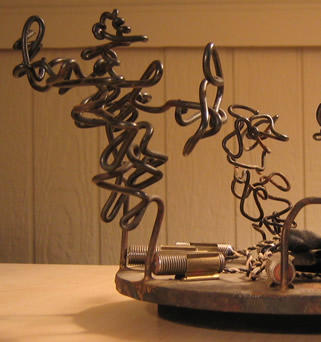 It's made of .080" piano wire (very thick tempered steel wire), which is bent with a pair of plyers and a blow torch into interesting shapes. The wires are then brazed onto a steel plate, and magnetic transducers are attached to pick up the vibrations. Csound is used to drop the sample by 1, 2, or three octaves.
Subscribe here:
This is a work in progress...
Subscribe here:
This is a work in progress...
Stay the same for a few bars, then change. The rhythm is 13 against 8. It doesn't sound as different as you might expect.Subscribe here:
This is a work in progress...
I keep removing more and more of the sounds to get more clarity. I deleted the bent spring and the welded piano wire sounds for now. I'll add them back. Or maybe piccolo?
Subscribe here:
This is a work in progress...
Subscribe here:
This is a work in progress...
Subscribe here:
This is a work in progress...
Subscribe here:
This is a work in progress...
Subscribe here:
This is a work in progress...
Subscribe here:
This is a work in progress...
Subscribe here:
This is a work in progress...
Increasing the audio location spread, the pitch climb, and the space between the notes.
Subscribe here:
This is a work in progress...
Subscribe here:
This is a work in progress...
Subscribe here:
This is a work in progress...
Subscribe here:
I think this one is finished for now. This is a piece for Finger Piano, Bass Flute, Cello, and Dry Spring. The Dry Spring is an amplified percussion instrument I made back in the 1970's for live performance. All the sounds are made with Csound as a sample based synthesizer. Tuning is 53 tone to the octave equal divisions of octave (53-EDO)
 The structure is kind of like a theme in C major, with a bridge in E minor, A minor, D minor, G minor. The E is a 5:4 above the C at 1:1, so a circle of fourths ends up on a G that is slightly flat. I solve that one by sliding up a step from 30 to 31. See the notes in Sagittal notation in the chart on the right. Each is moved around by the 53rd root of 2, the single step of 53 EDO, a ratio of 77:76. These steps are so small that it is hard to notice that the key has modulated by one, two, or three steps, and then back down.
 One section at the end includes a longer bridge that includes the keys shown on the left. They start at kind of an A flat, and move up by fourths until they hit the G a 3:2 above the C at 1:1.
The finger piano samples are from an instrument I made in the 1970's also, when I was playing more live. It has a nice solid base and piano like middle, and harp like highs. By truncating the envelope, I can make it sound more like a Fender Jazz Bass with plastic strings. This envelope is shown below. 
The end includes arpeggios of the finger piano with an envelope like the chart at the bottom.

