Tuesday, June 22, 2010

Amazing Grace - up & down

Today's post uses a Csound function table to make trills and slides. At any given time, the notes can either be played straight, trilled up to the target, from the target to the next note, slid up to the target, or down to the target note. This makes for some frantic movements at first. This is just a few measures of one chord, and there are 35 in Amazing Grace.

Here's the code for a trill up 16 steps in 72 EDO, which is a good approximation of a 7:6. The trill is 8 times up and down.
f 457 0 256 -7 1 16 1 0 1.1665290 16 1.1665290 0 1 16 1 0 1.1665290 16 1.1665290
0 1 16 1 0 1.16652904 16 1.16652904 0 1 16 1 0 1.16652904 16 1.16652904
0 1 16 1 0 1.16652904 16 1.16652904 0 1 16 1 0 1.16652904 16 1.16652904
0 1 16 1 0 1.16652904 16 1.16652904 0 1 16 1 0 1.16652904 16 1.16652904
; 7:6 156 up & down .trl7:6 g156

Graphically it looks like this:

Play it here: or download this linkSubscribe here: to this RSS feed

Saturday, June 19, 2010

Amazing Grace - slip sliding away

Today's entry has each not choosing to either slide to the next note or not, and the duration before the slide starts varies from 1/3 to 1/10th the duration of the note. For example, if I need to slide up 6 72 EDO steps, I code the following in csound:

lf 315 0 256 -6 1 218 1.0000000 12 1.0000000 12 1.0297315 12 1.0594631 1 1.0594631 1 1.0594631 ; 14 up 6 a
lf 363 0 256 -6 1 110 1.0000000 48 1.0000000 48 1.0297315 48 1.0594631 1 1.0594631 1 1.0594631 ; 14 up 6 c

This gives me one function table that rises fast, and another that's slower.
The fast one:

The slow one:

The preprocessor chooses either one, or one that doesn't slide at all.

Play it here: or download this linkSubscribe here: to this RSS feed

Wednesday, June 02, 2010

Amazing Grace - sketches for a transformation

This is a work in progress. Today's sketches use my microtonal slide piano. The chords can slide from a 7:9:11 to 4:5:6, in various inversions. Csound allows for any function table to control the pitch, so I used several that are similar to this one:


The Csound code looks like this:

f 471 0 129 -6 1 4 1 4 1 16 1.0400 16 1.0801 4 1.0676 4 1.0551 4 1.0676 4 1.0801 4
1.0676 4 1.0551 4 1.0676 4 1.0801 4 1.0676 4 1.0551 4 1.0676 4 1.0801 4 1.0676 4
1.0551 4 1.0676 4 1.0801 4 1.0676 4 1.0551 4 1.0676 4 1.0801 4 1.0676 4 1.0551


The function starts at 1 and rises to 1.0801, which is 8 steps in 72 EDO, approximately a 13:12. I have a few dozen of these for the most common intervals. It falls by a single 72 EDO step and goes back up for 8 cycles or so. I think it sounds like a guitar whammy bar.

I'm not sure what this has to do with Amazing Grace, except that the first chord of the song is a G major. Just like Amazing Grace!

Play it here: or download this linkSubscribe here: to this RSS feed

Wednesday, May 26, 2010

Amazing Grace - untransformed

This is a work in progress.

I have some ideas about transforming Amazing Grace, probably the most transformed hymn in the history of music. I especially like Ben Johnston's 4th string quartet, which uses the material as a jumping off point into definitely non-hymnic areas. Today's post is just a simple version of the hymn on a spinet sample.

Play it here: Or download this link
Subscribe here: to this RSS feed

Tuesday, April 13, 2010

Drei Equale

This is a work in progress. I've made a few updates to the ratios of some of the notes to take the advice of some microtonalists. My ratios are shown on the JPG below in blue, Marcel de Velde's in black. I tried to eliminate the wolfs. The differences are small to Marcel's choices, a 7/6 instead of an 6/5 at chord 12 to enable the 7th overtone, and several choices that are 81/80 or 64/63 different. What's a 225/224 among friends? (chord 27: I like the 7/5, he has 43/32. I'm trying to make sure that when you hear a 3/2, it is a 3/2, and not a 20/27 or a 45/64, or something like it. That's my rule for now. See measure 5, where I've changed the 9/8's to 10/9, to keep a 3/2 instead of the 20/27.

Click to make it bigger.

Play it here: or download this link
Subscribe here: to this RSS feed

Monday, April 05, 2010

O Sacred Head, Now Wounded - #14

For this version, I switched from 72-EDO to pure just, to hear the effect. The samples I use are as in well tuned as I can get them, but I still hear beats in some chords, even with pure just intonation. Some of the samples move around in pitch as they transition from the attack to sustain. I can imagine those poor guys in a room playing into a microphone trying to hit a pitch. There's only so much you can do with human beings, I guess.

Play it:


Subscribe here: to this RSS feed

Sunday, April 04, 2010

Drei Equale - Beethoven Trombone Quartet

This is a work in progress. Marcel de Velde has asked several microtonalists to apply our intonation efforts to retuning Ludwig Von Beethoven's Drei Equale for trombone quartet. Here's my first pass at the first 21 measures. I used Csound and a trombone sample from the McGill University Master Samples library. I don't have any midi tools available.

I've used some strange ratios, especially for the diminished triads. Measure 12 starts with a D minor, which I use 10/9 4/3 5/3. In the next chord, the A becomes an Ab to make a diminshed triad. I chose the ratio of 14/9. That makes a 5:6:7 ratio, as in the otononality scale. How else to chose? Where did the diminished triad originate?

There is another diminshed triad in measure 17, last note. I chose 6:11:13 here, and it really sticks out. Maestro LVB would not approve. Any better ideas?

Play it:


Subscribe here: to this RSS feed

Saturday, April 03, 2010

Now Thank We All Our God #9


This is a work in progress. This is the current ninth take. It's shorter than the others, at just under eight minutes. The algorithm chooses how long to stay on each chord from a list of choices, one to five beats, then repeats it zero to two times. That way, it can be as short as one beat to as long as fifteen beats on each chord.

Play it:


Subscribe here: to this RSS feed

Friday, April 02, 2010

Now Thank We All Our God

This is a work in progress. Today's version is mostly complete. I've generated four and will pick one as the final version.

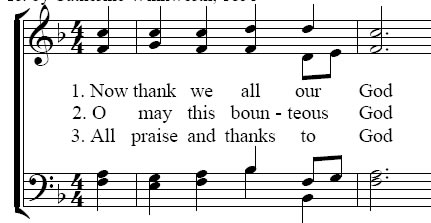
This version is another of my Transformed Hymns, which take a familiar hymn tune and stretch it out a bit. Each chord of the hymn becomes a measure or several measures of the transformation. Now Thank We All Our God is a Felix Mendelssohn harmonization of a 17th century tune. There are many unusual chord voicings in the arrangement I have, from the Center for Church Music. There are sevenths in the bass and other unusual arrangements. There are also some challenging comma issues, which I work through by switching from one note to another to preserve the harmony. My goal is to make a good just chord, and so I sacrificed melodic consistency sometimes. If a note starts out as a 16/9 to go with a 4/3, then drifts down to a 7/4 as the 7th in a major chord, it does it. No questions asked. Listen at around 1:45 in this version for the gradual 2 step in 72EDO fall in the Bb. Here it is in score form:


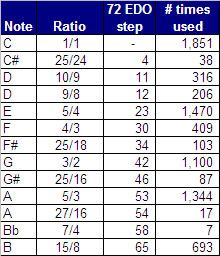
Here is a chart of the notes that I used in the piece. Notice how often the C, F, G, A, Bb are used, and that lonely G# passing tone as a major third to the E natural.

The piece is scored for flutes, clarinets, french horns, trombone, tuba, finger pianos, regular pianos, harp, marimba, and vibraphone.

Play it:


Subscribe here: to this RSS feed

Sunday, March 28, 2010

Nosing around some more with ratios

Nosing around further, I noticed that there was no requirement to use the Bb at ratio 16/9 in chord number 38. 7/4 is much nicer, and gets more exposure to the true 7th. I keep the G at 40/27 glides to 3/2. To clarify the tones, I switched out the horns for sine waves.

Play it:


Subscribe here: to this RSS feed

Now Thank We All Our God - find those commas!

I'm still working my way through this one. I've found a few errors in my note choices today. At one point the score calls for a D and a G, and I used the D at ratio of 10/9 instead of the 9/8 to go with the G at 3/2. Not so nice.

At one point in chords 35 - 39 I need a G to go with the D at 10/9 and the Bb at 16/9, and with a C 1/1 E 5/4. So I chose a G 40/27 that drifts up by a step in 72 EDO to a G at 3/2 when it needs to match the C1/1. See the chart for the details. This section is heard at the end of today's excerpt. Find those commas to solve the wolf problems.

Play it:


Subscribe here: to this RSS feed

Tuesday, March 16, 2010

Now Thank We All Our God - quite the crowd

This is a work in progress. Tonight, as I was enjoying my evening alone in the Salt Lake City Hilton near the airport, Omar showed up with his spinet, a blind guy who played the vibes, and a one armed marimba player. Next thing you know, the guy in the room down the hall knocked on the door. He said he could play four clarinets at once. In 72 EDO! I have never seen that before. So I had to record one more take of the first seven chords of Now Thank We All Our God. Heavenly. Fake but accurate...

Play it:


Now Thank We All Our God - loud piano

This is a work in progress. I used the FF piano samples this time. I need to figure out a way to chose the samples based on the volume.

Play it:


Subscribe here: to this RSS feed

Monday, March 15, 2010

Now Thank We All Our God


This is a work in progress. I'm just starting up this one, for piano, harp, finger piano, brass, and flutes.

Play it:


Subscribe here: to this RSS feed

Friday, March 12, 2010

A Mighty Fortress Is Our God - Transformed take 9

I retuned the instrument samples using a much more accurate tool (my ears). The high flute samples were out of tune before. Now they sound much better. I also fixed a bug in the hold values for the flute part in the last section, so that they don't get chopped off early. This version should be the last one posted.

Play it:


Subscribe here: to this RSS feed

Wednesday, March 10, 2010

A Mighty Fortress Is Our God - Transformed take 5

This version is much tighter now, and I think it's finished. The hymn tune was written by Martin Luther in 1529, and harmonized by Bach in 1740 or so. This version stretches each chord in a variety of ways. Each chord can be 2, 3, 4, or 5 times longer than normal, and is repeated 1, 2, or 3 times before moving on to the next chord. There is a variable repetition scheme that includes stepping through the choices of arpeggios in sequence, forward and backward, and staying put for a while. The tempo shifts constantly, as does the volume.

The intonation system is chosen from the 72 EDO scale. The notes include the following:

Notice how many more times C, E, G, and A are played. The two D's are less than half as common, and that lonely 7/4 is only played 7 times. See if you can hear it, towards the end.

This version is scored for vibraphone, marimba, finger piano, tuba, trombone, French horn, and flutes.

Here is a link to a nice PDF of the file on the Center for Church Music site. It's not the one I used, but it's close.

Play it:


Subscribe here: to this RSS feed

A Mighty Fortress Is Our God - Transformed

This is a work in progress. It's a bit long now. I'll have to figure out a way to shorten it up a bit.

Play it:


Subscribe here: to this RSS feed

Saturday, March 06, 2010

A Mighty Fortress Is Our God

This is a work in progress.

Play it:


Subscribe here: to this RSS feed

Martin Luther is credited with this hymn in 1529. Today i present a simple statement of the opening few notes. Familiar? I can't decide if the penultimate chord, on the word "Our" should be
D 10/9 - F# 25/18 - A 5/3

or
D 9/8 - F# 45/32 - A 27/16.
Decisions, decisions. Here it is as the latter.

Play it:


Thursday, March 04, 2010

I just noticed this video of a 60x60 concert in NYC with my short piece for
bassoon, bent wire spring, and percussion board.


60x60 Dance (2008 International Mix) performed at the World Financial Center Winter Garden in New York City on Friday, November 14, 2008. Music: Prent Rodgers Dance: Elana B Cohen

The rules stipulate that all compositions be no more than 60 seconds in length, which are assembled into concerts of 60 at a time. The whole operation is run by Robert Voisey. More information here: http://www.VoxNovus.com

For this 2008 performance, Robert enlisted a group of very talented dancers. More here.


He has also worked with Aaron Krister Johnson on a microtonal 60x60, which I think has been assembled for a concert in Chicago that Aaron is organizing for April 27th MCA Chicago 60x60/UnTwelve mix.

Prent Rodgers

Update: Here is a picture of the "Bent Wire Spring", an instrument I built back in the 70's. It is a block of birch, about 3/4" by 4" by 10", with a groove cut out for an angle iron fabrication with mid-gauge piano wires coming out. In the middle of the angle iron is a hand wound magnetic pickup that goes to an amplifier. The piano wires are bent into random shapes. You pluck the wires and each makes its own enharmonic spectrum with deep bass tones and an assortment of harmonics. Click the photo to enlarge.

Tuesday, March 02, 2010

The Music of the Hoh River Valley CD now up on iTunes

I worked with CDBaby (and paid them $45) to put my last CD up on iTunes. It took a few weeks, but you can find it now on iTunes. It's an experiment.